-
 USD
USD 
 INR
INR

Types of Linux Operating Sys...

Types of Linux Operating Systems for Web Server
How to Choose best Linux Os for Web Hosting
When it comes to web hosting, Linux has always been the go-to choice for businesses and developers. Its open-source nature, stability, and strong community support make it ideal for hosting websites, applications, and databases. But not all Linux distributions (distros) are the same—each comes with its own strengths.
Below, we’ll explore the most popular Linux OS types used in web hosting and where they fit best.

CentOS
CentOS has long been a favorite for web hosting companies because it mirrors the enterprise-grade Red Hat Enterprise Linux (RHEL) but comes free of cost. Many control panels like cPanel/WHM were originally built with CentOS in mind.
- Best for: Stability, enterprise-grade hosting
- Why choose it: Long-term support, reliability, proven performance
- Downside: CentOS 8 reached its end-of-life in 2021, leading many providers to switch
Ubuntu Server
Ubuntu is one of the most user-friendly Linux distros and is widely adopted in cloud hosting environments. Its frequent updates and strong community support make it suitable for both beginners and advanced administrators.
- Best for: Cloud hosting, startups, developers
- Why choose it: Easy to use, massive documentation, frequent updates
- Downside: Shorter support cycle compared to CentOS/RHEL
Debian
Debian is known for its rock-solid stability and strict testing before software is released. Many web hosts prefer Debian for its security and reliability. Popular control panels such as ISPConfig work seamlessly with Debian.
- Best for: Security-focused hosting
- Why choose it: Stable, secure, trusted in mission-critical environments
- Downside: Software versions are often older due to long testing cycles
AlmaLinux
When CentOS announced the end of CentOS 8, AlmaLinux emerged as a community-driven, open-source replacement. It is 1:1 binary compatible with RHEL, making it an easy migration path for hosting providers.
- Best for: Replacing CentOS in production hosting
- Why choose it: Long support cycle, enterprise-level stability, backed by CloudLinux
- Downside: New compared to older distros, but quickly gaining adoption
Fedora Server
Fedora is often seen as the “testing ground” for Red Hat Enterprise Linux. It includes cutting-edge features and newer technologies, making it attractive for developers who want to stay on the edge.
- Best for: Development and testing environments
- Why choose it: Latest software, active development
- Downside: Short life cycle (updates every 13 months)
CloudLinux
CloudLinux is a commercial Linux distribution designed specifically for shared hosting providers. It improves server stability by isolating each user into their own “Lightweight Virtual Environment” (LVE). This prevents one customer’s heavy resource usage from affecting others on the same server.
- Best for: Shared hosting environments
- Why choose it: Enhanced stability, security isolation, resource management
- Downside: Paid license required (not free like other Linux distros)
Choosing the right Linux OS for web hosting depends on your needs:
- CentOS/AlmaLinux/Rocky Linux → Stability and enterprise hosting
- Ubuntu/Debian → Developer-friendly, flexible hosting
- Fedora → Innovation and testing environments
- CloudLinux → Shared hosting with enhanced security and stability
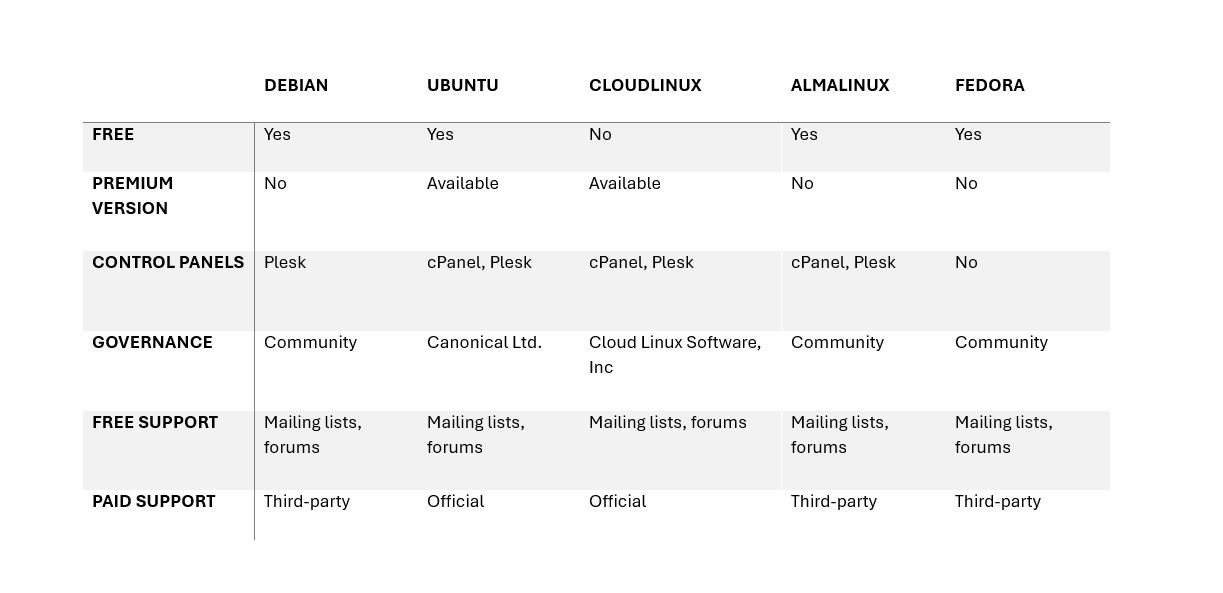
For businesses, stability and long-term support usually matter most. For developers, newer features and ease of use may take priority. Regardless of the choice, Linux continues to be the backbone of the web hosting world.

